In a historic diplomatic moment, US President Donald Trump and Chinese President Xi Jinping met in Busan, South Korea, marking their first face-to-face interaction in six years. The meeting comes amid rising tensions between the world’s two largest economies and global powers. Their last meeting took place at the G20 Summit in Osaka, Japan, in 2019, during Trump’s first presidential term.
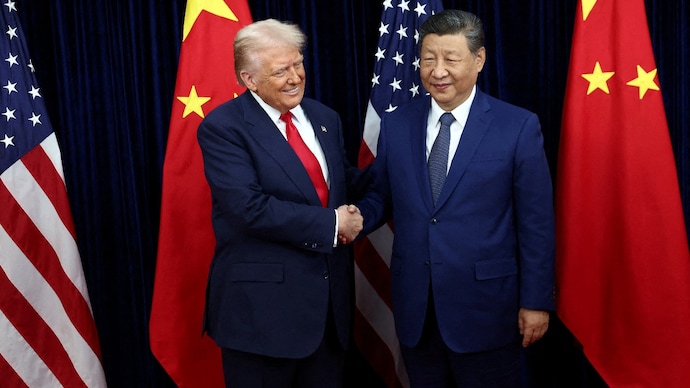
The renewed encounter between the two leaders — both strong personalities known for their bold political stances — is being seen as a key attempt to rebuild communication channels and stabilize relations that have worsened over the past few years.
A Long-Awaited Meeting
This meeting had been in the works for months. Following Trump’s return to the White House in January, both Washington and Beijing signaled a cautious willingness to reopen dialogue. Busan, chosen as a neutral diplomatic venue, served as a strategic location, symbolizing the balance between US alliances in Asia and China’s regional influence.
According to White House officials, the meeting focused on reducing trade friction, addressing technology restrictions, and discussing regional security issues, including North Korea’s growing missile program and the Taiwan Strait situation.
The symbolism of this encounter goes far beyond the handshake — it represents an attempt to reset global diplomacy after years of competition, tariffs, and military tension.
Backdrop of Tense US-China Relations
Over the past decade, relations between the United States and China have deteriorated sharply. The friction began during Trump’s first term, when he launched a trade war against Beijing, accusing China of unfair trade practices and intellectual property theft.
Subsequent years saw both nations imposing tariffs on each other’s goods worth hundreds of billions of dollars. The tensions expanded into technology, with Washington banning major Chinese companies such as Huawei and TikTok from key sectors, citing national security risks.
Adding to the strain were military activities in the South China Sea and US support for Taiwan, which China claims as its territory.
Now, with global instability caused by wars, economic uncertainty, and supply chain disruptions, both sides appear to be seeking a calmer, more pragmatic relationship.
hellocarbondale.com | LogInomaSlot.info | BagLens.com
ShallowReefAquarium.com | AmericanBikerEvents.com
Key Topics Discussed
1. Trade and Economy
Both Trump and Xi reportedly discussed the need to rebalance trade and address supply chain dependencies that have affected industries worldwide. Trump, who has always prioritized “America First,” emphasized that any new trade deal must benefit American workers, while Xi reiterated China’s right to fair competition.
They also explored ways to reduce tariffs on certain products to stabilize prices and global markets.
2. Technology and AI Regulation
Another major area of discussion was the control of emerging technologies, including artificial intelligence, semiconductors, and cybersecurity. The US has placed severe restrictions on China’s access to advanced chips, while Beijing has responded by boosting its domestic tech production.
Both leaders acknowledged that cooperation in AI governance and cyber safety is necessary to prevent misuse and maintain global security.
3. Regional Security and North Korea
Given the meeting’s location in South Korea, North Korea was a key topic. Both countries expressed concern over Pyongyang’s frequent missile tests and nuclear ambitions. Trump reportedly called for a joint effort to bring North Korea back to diplomatic talks, while Xi urged restraint and the resumption of multilateral peace frameworks.
4. Taiwan and South China Sea
The discussion turned sensitive when the topic of Taiwan arose. Trump reiterated the US’s commitment to peace and stability in the Taiwan Strait while maintaining Washington’s long-standing “One China” policy. Xi warned against “external interference” in Chinese sovereignty, signaling that Taiwan remains a non-negotiable issue for Beijing.
Both leaders agreed to keep communication open to avoid military misunderstandings in the Indo-Pacific.
Global Reactions
The Trump–Xi meeting has sparked a wave of global responses. World markets reacted positively, with Asian stock indices rising amid hopes of easing tensions between the two largest economies.
European Union leaders welcomed the dialogue, calling it a “positive step toward global stability.” Meanwhile, Japan and South Korea, both key US allies, expressed cautious optimism but emphasized that words must lead to “meaningful de-escalation.”
However, some analysts remain skeptical. Critics in Washington argue that China may use the talks to buy time and strengthen its regional influence, while Chinese media has portrayed Trump as unpredictable and politically motivated ahead of the 2028 elections.
Diplomatic Significance
The meeting also marks a strategic shift in US diplomacy. Trump’s decision to meet Xi in South Korea — a close American ally — signals that Washington intends to maintain its dominance in the Indo-Pacific while engaging directly with China.
For Beijing, the meeting offers an opportunity to soften its global image, rebuild economic trust, and counterbalance the growing influence of Western-led trade alliances such as the Indo-Pacific Economic Framework (IPEF).
The Busan summit highlights that dialogue, not confrontation, may be the path forward — even between rivals with deep-rooted differences.
Experts Weigh In
International experts say the Trump–Xi meeting could shape the future of global geopolitics.
Dr. Lisa Chen, a political analyst at Georgetown University, remarked:
“The fact that Trump and Xi met face-to-face is itself progress. Both leaders understand that prolonged hostility benefits neither nation.”
Arjun Menon, a trade expert, added:
“The trade war years hurt both economies. The global supply chain needs balance, and this meeting might be the first step toward that.”
However, former US diplomats caution against expecting too much too soon. “China’s long-term strategic goals remain unchanged,” one said, “and Trump’s unpredictable nature means this truce could be temporary.”
The Road Ahead
While no major agreements were signed in Busan, both sides agreed to reopen regular high-level dialogues between their foreign ministries and economic teams. The next meeting between US and Chinese defense officials is also expected later this year.
The two leaders concluded the summit with a joint statement emphasizing the importance of “peaceful coexistence, mutual respect, and responsible competition.”
The tone was markedly different from the fiery rhetoric of previous years. Observers believe that both Trump and Xi, facing domestic and international pressures, have realized the need to manage competition rather than fuel conflict.
Conclusion
The Trump–Xi meeting in South Korea could prove to be one of the most consequential diplomatic events of the decade. Though it didn’t result in immediate breakthroughs, it symbolized a willingness to rebuild dialogue and prevent further deterioration in US–China ties.
For the world, this meeting offers a glimmer of hope — that even amid rivalry, the leaders of two powerful nations can find common ground in diplomacy. Whether this marks the start of genuine cooperation or a temporary ceasefire remains to be seen, but for now, Busan has reminded the world that communication is still the most powerful tool in global politics.