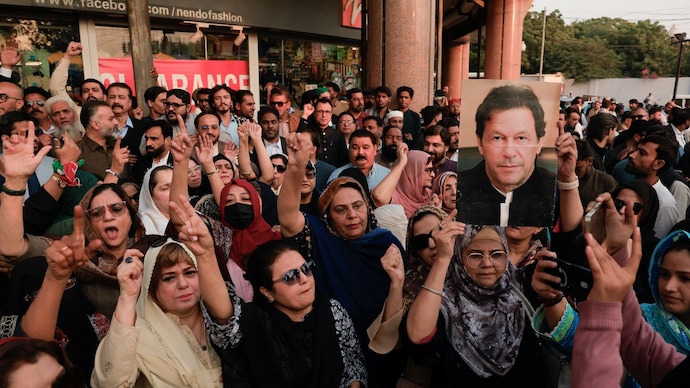
Pakistan is bracing for heightened political tension as supporters of former Prime Minister Imran Khan gear up for major protests in Islamabad and Rawalpindi. The demonstrations, planned by Khan’s party—Pakistan Tehreek-e-Insaf (PTI)—come at a time when the government has imposed strict restrictions on large gatherings, raising concerns about possible clashes, arrests, and further instability in an already volatile political landscape.
Background: Why Are the Protests Happening?
Imran Khan, once one of Pakistan’s most influential and popular political figures, has been in detention at Rawalpindi’s Adiala Jail since August 2023. Over the past year, he has faced multiple legal cases, ranging from corruption and state secrets to contempt-related allegations. PTI has consistently claimed that these cases are politically motivated and part of a broader effort to eliminate Khan from national politics.
Khan’s supporters have repeatedly demanded his release, calling him a symbol of resistance against what they describe as an “unfair crackdown” on the party. PTI leaders say that the upcoming protests aim to highlight what they view as unlawful detentions, the suppression of political rights, and a lack of transparency within the justice system.
The demonstrations have been scheduled near two symbolic and strategic locations:
-
Adiala Jail, where Khan is being held.
-
The Islamabad High Court, a central point for hearings related to his multiple legal battles.
topcbdsites.com | FooDoFast.com | highcasinotips.com
pokerglobalclub.com | businessemailbest.com
Gathering Restrictions and Security Measures
In a move that significantly affects PTI’s protest plans, authorities in Rawalpindi and Islamabad have imposed bans on large public gatherings under Section 144. This law prohibits any assembly of more than four people, processions, or political rallies, citing security concerns.
Officials argue the bans are essential to prevent violence, ensure public safety, and maintain order. They point to previous rallies that resulted in confrontations between PTI supporters and law enforcement agencies, sometimes leading to property damage and injuries.
To enforce the restrictions, the government has put in place several measures:
-
Heavy deployment of police and paramilitary forces around key locations
-
Roadblocks and checkpoints near Adiala Jail and the Islamabad High Court
-
Surveillance and drone monitoring to track crowd movement
-
Warnings issued to PTI leaders that unauthorized gatherings may lead to arrests
Despite these warnings, PTI maintains its stance that peaceful protest is a constitutional right.
PTI’s Strategy and Mobilisation Efforts
PTI leaders have been actively urging supporters to join the planned protests, calling the movement a “fight for justice and democracy.” Speeches, social media campaigns, and press conferences have all been used to mobilize the party’s core supporters.
The party has framed the protest as:
-
A show of solidarity with Imran Khan
-
A pushback against alleged political victimisation
-
A challenge to what they call the misuse of state power
-
A symbolic assertion of PTI’s relevance despite internal leadership challenges and legal troubles
While PTI insists the protests will remain peaceful, authorities remain cautious given past episodes where rallies have escalated into unrest.
Concerns Over Possible Confrontation
Political analysts warn that the situation could become tense, especially around Adiala Jail, a heavily fortified facility. Any attempt by large crowds to gather near the prison could trigger a swift police response.
Key concerns include:
-
Risk of clashes between protesters and law enforcement
-
Arrests of PTI workers, further fuelling anger within the party
-
Disruption of public life, especially in Rawalpindi’s busy areas
-
Increased political polarisation amid already strained civil-military relations
Authorities have reiterated that any violation of Section 144 will be “handled according to law.”
Impact on Pakistan’s Political Climate
Imran Khan’s imprisonment and PTI’s protests continue to dominate Pakistan’s political narrative. With an already unstable economic environment, strained relations between political parties, and ongoing civil-military tensions, the scheduled protests add another layer of complexity.
For many observers, the protests highlight:
-
A deep mistrust between the public and the government
-
A divided political landscape, with no clear path toward reconciliation
-
PTI’s resilience, showing it still commands significant public support
-
The state’s uncompromising approach, prioritising security over political dialogue
These protests also come at a time when Pakistan is facing economic challenges, inflation pressure, and governance issues—factors that heighten the impact of any political unrest.
Public Reaction and Social Media Buzz
On social media platforms, PTI supporters have been actively sharing updates, calling on people from Islamabad, Rawalpindi, and nearby cities to show up for the demonstrations. Hashtags related to Imran Khan, Adiala Jail, and PTI protests have been trending, reflecting the strong emotions surrounding the issue.
While PTI supporters praise Khan as a leader committed to transparency and reform, critics argue that the party is knowingly encouraging confrontation and instability.
What Happens Next?
The coming days are crucial. If PTI supporters go ahead with the protests despite restrictions, several outcomes are possible:
-
Strict police action to disperse crowds
-
Mass arrests, especially of key PTI workers
-
Further strain between PTI and the establishment
-
Possible legal action against PTI leaders for violating Section 144
-
Or, less likely but possible, a negotiated compromise allowing controlled demonstrations
The government hopes its restrictions will deter mass mobilization. PTI, on the other hand, appears determined to send a political message, even at the risk of confrontation.
Conclusion
The planned protests in Islamabad and Rawalpindi reflect a critical moment in Pakistan’s political journey. As Imran Khan remains behind bars and his supporters prepare to rally despite bans, the country once again finds itself at the crossroads of political expression and state authority.
Whether the protests proceed peacefully, result in mass arrests, or escalate into open conflict will largely determine the tone of Pakistan’s political climate in the coming weeks. For now, both the government and PTI appear firmly committed to their positions, setting the stage for a tense and closely watched development.